
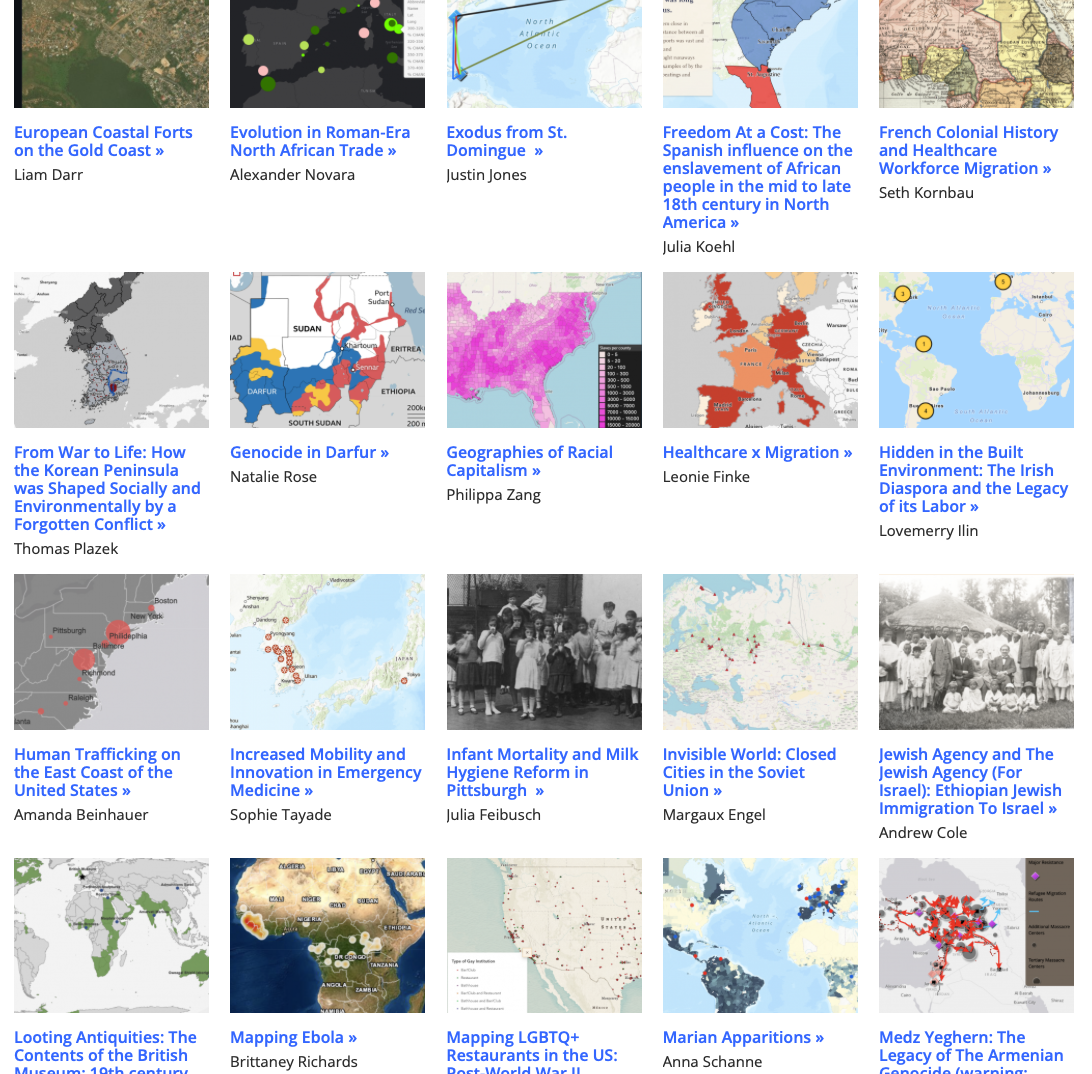
A collage of past Digital Atlas Projects completed by interns.
After eight years, the Digital Atlas Design Internship marks its final chapter at the World History Center. Launched by former WHC Director Ruth Mostern in 2017, the internship became a cornerstone of the Center’s mission, training over 100 undergraduate students who compwho completed unique independent research projects that wove historical research, data analysis, digital mapping, and narrative crafting.
The Digital Atlas Design Internship was former Director Mostern's brainchild. “The goal was to create a rigorous, fun, and public-facing experience in which students could produce original scholarship and contribute to an ever-growing global archive of digital maps integrating images, authored narrative, and spatial analysis,” she reflects.
“I am immensely proud of what almost one hundred students accomplished over the eight years of the internship. They have collectively built a dynamic interactive atlas that is itself a map of the world.” --Ruth Mostern, former director of the WHC and director of the Institute for Spatial Historical Innovation (ISHI)]
The internship’s success was built on a unique model that blended the communal learning of a traditional seminar, the individual mentorship of a thesis project, and the skill cultivation of an internship. This robust support consisted of three individuals. The WHC Digital History Postdoctoral Fellow was the primary instructor for the internship; the Center director oversaw its pedagogical trajectory; and the content advisors offered specialized expertise on the subject matter. This structure granted students the intellectual freedom to explore original topics while ensuring their findings were presented in a public-facing format. Through this model, students not only gained hands-on research experience and learned about a subject of interest, but they also built expertise in GIS, web design, and the digital humanities.
Justin Jones, a former Digital Atlas Design intern and now Ph.D. student at Vanderbilt University, shares how the internship helped him to prepare for graduate school:
"Complementing my historical and linguistic education at Pitt with this digital humanities experience taught me so much about the research process and incorporating technology into it,and allowed me to produce projects that helped me immensely with getting into doctoral programs in history."
In the future, students who are interested in mapping should consider the Institute for Spatial Historical Innovation (ISHI)’s Interconnected Places Lab Internship (HIST1907), a three-credit undergraduate internship to be offered in Fall 2026.
While this chapter of the WHC concludes, its mission of undergraduate education and public history continues. Beginning in 2026-2027, the World History Center will be launching a new initiative. Entitled the Global Public History Lab, it will give undergraduate students the opportunity to explore the global history of a topic of interest by working with a library, a museum, a business, or any other institutions with archives that have a story to tell. Like the Digital Atlas Design Internship, students will have access to three levels of support: a primary instructor (Professor Vipin Krishna), who will provide weekly guidance, the Center director who will oversee the pedagogical trajectory, and a content advisor of their choosing who will offer specialized expertise on the subject matter. The final project will be a website, a video, a podcast, a physical or digital exhibition, or any other format that uses the tools of the historian to bring global stories hidden in local archive to a broader public.